
No items found.
Managing asbestos in your school starts with knowing where asbestos-containing materials (ACMs) are located, what condition they are in and how they could be affected by everyday use, maintenance or planned building work.
Asbestos does not automatically need to be removed simply because it is present. Where ACMs remain in good condition and are unlikely to be disturbed, they can often be managed in place. Asbestos removal may become necessary where materials are damaged, difficult to protect or likely to be disturbed during refurbishment, maintenance or demolition.
This guide explains how schools can manage asbestos, when removal may be required and how removal projects can be planned around pupils, staff and day-to-day school activities.
To discuss asbestos management or removal at your school, call 0800 358 1100.
Many school buildings were constructed or refurbished during periods when asbestos-containing materials were widely used. ACMs were common in these structures as asbestos was cheap, fireproof and a good thermal insulator.
Asbestos was used extensively in school buildings from the 1950s onwards, including large quantities in system-built premises constructed during the 1950s, 1960s and early 1970s. It can be found in roofs, wall and ceiling panels, service ducts, pipework, plant rooms, floor finishes and other parts of the building fabric.
The presence of asbestos does not automatically mean removal is required. ACMs that remain in good condition and are unlikely to be damaged or disturbed can often stay in place as part of an appropriate management plan.
Problems are more likely to arise when asbestos is damaged or disturbed. Maintenance, repairs, installation work, refurbishment and other activities affecting the building fabric can all bring workers into contact with ACMs if suitable information is not available beforehand.
Asbestos can release fibres when an ACM is damaged or disturbed, which can become airborne and may be inhaled. Inhaling asbestos fibres can cause serious diseases, including mesothelioma, asbestosis and asbestos-related lung cancer. These conditions often take decades to develop after exposure.
According to the British Safety Council, more than 450 school teaching professionals have died of mesothelioma in Britain since 1980, more than 300 of whom have died since 2000. This number is anticipated to be an underestimate, as the figures do not include those aged 75 and over.
For schools, effective asbestos management is largely about preventing unplanned disturbance. Caretakers, maintenance teams, electricians, plumbers, IT contractors and other trades may carry out work that affects walls, ceilings, floors or service areas where asbestos is present.
The aim is not to remove every ACM from every school. It is to maintain accurate information, assess condition and likelihood of disturbance and take suitable action before anyone starts work that could affect the material.
The main legal requirements are set out in the Control of Asbestos Regulations 2012.
Regulation 4 places a duty to manage asbestos in non-domestic premises on those with responsibility for maintenance and repair. The requirements include identifying whether asbestos is present or liable to be present, recording its location and condition, assessing the risk and preparing a plan for managing it.
The plan then needs to be implemented, monitored and kept up to date. Relevant asbestos information must also be provided to people who could disturb ACMs through their work.
Other legislation can also apply depending on the work being carried out:
HSE guidance provides further detail on putting these duties into practice. HSG264 covers asbestos surveying, while HSG227 explains how asbestos should be managed in premises.
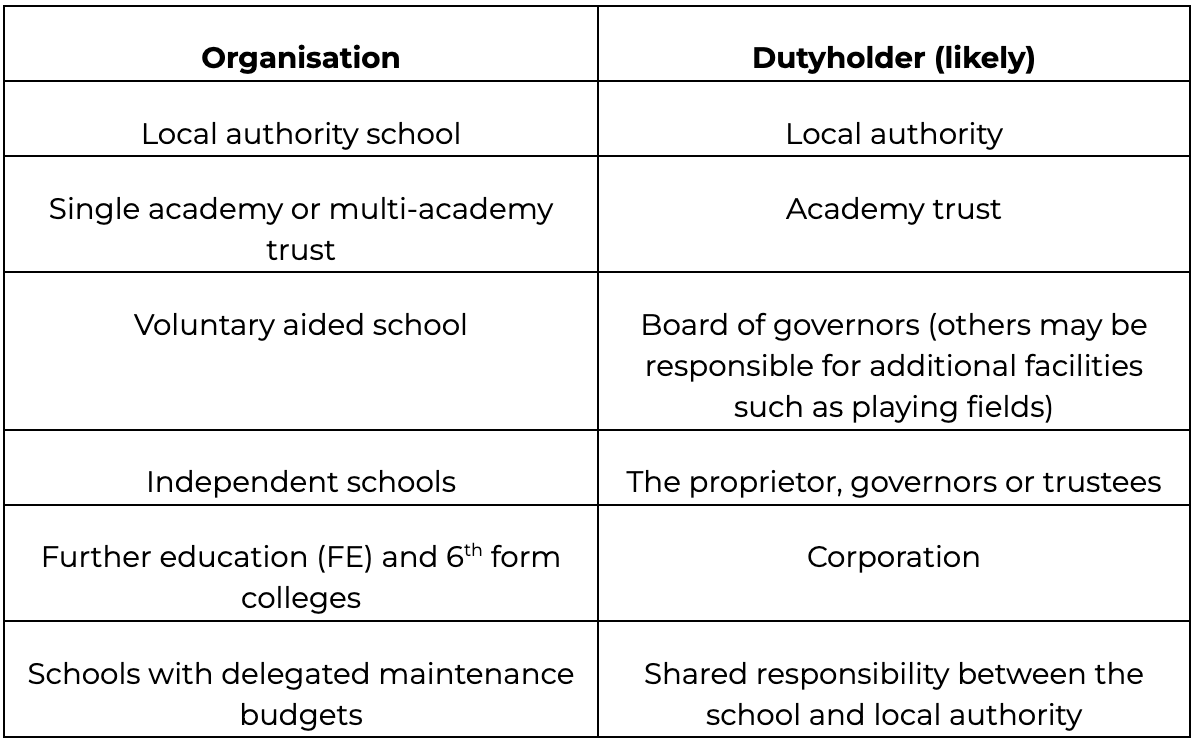
The process of managing asbestos in your school can be broken down into five key steps:
01 – Determine Responsibility
Start by confirming who has responsibility for maintaining and repairing the premises.
Where responsibility is shared between a school, academy trust, local authority or another organisation, the division of duties should be understood and documented.
02 – Check the Asbestos Information Available
The dutyholder needs suitable information about whether ACMs are present, where they are located and their condition.
An asbestos survey may form the basis of this information. Survey reports should also be checked for limitations and areas that were not accessed.
For normal occupation and routine maintenance, a management survey is generally used to identify ACMs that could be disturbed during foreseeable activities.
More intrusive work needs different information. Where refurbishment or demolition will affect the building fabric, the survey needs to cover the areas that will be disturbed.
03 – Maintain an Asbestos Register
Survey information should be used to maintain an asbestos register recording known and presumed ACMs, their locations and their condition. Survey findings should also be reviewed for any remedial actions that need to be prioritised, with the register updated whenever the recorded information changes.
It should also be made available to anyone who needs it before carrying out work that could disturb ACMs.
04 – Develop an Asbestos Management Plan
The asbestos management plan should set out the risks from identified ACMs and how those risks will be controlled.
This may include monitoring, restrictions on access or activities, labelling, repair, encapsulation or removal where appropriate.
05 – Ensure Implementation
Once the AMP is complete, the dutyholder needs to ensure it is implemented and kept under review. An appointed person can assist with the day-to-day management arrangements, but the legal duty remains with the dutyholder.
Before maintenance or construction work starts, check whether the proposed activity could affect an ACM or an area that has not been adequately surveyed.
If asbestos removal is required, the work needs to be planned around both the ACM and the way the school operates.
Accurate survey information and a defined scope should establish what will be disturbed, which areas will be affected and what controls are required. The work may be non-licensed, notifiable non-licensed work (NNLW) or licensable depending on factors including the material, its condition, the task and likely exposure.
Practical considerations can include:
Working during a school holiday does not change the asbestos controls required. The removal still needs to be assessed and planned according to the specific project.
Current asbestos legislation does not set a universal deadline for removing every ACM from a school. The duty remains to identify asbestos, assess its condition and manage the risk appropriately.
There have been calls for a longer-term programme of asbestos removal from non-domestic buildings, including recommendations made by the House of Commons Work and Pensions Committee in 2022.
For individual schools, however, decisions still need to be based on the condition of the ACMs and the work planned for the building.
This becomes particularly relevant as older school estates undergo refurbishment and upgrades. Before work disturbs the building fabric, existing asbestos information needs to be checked to establish whether it is sufficient for the proposed project and whether further surveying or remedial work is required.
EMS has supported asbestos projects since 2003, working with schools and other organisations across the UK.
We can provide support at different stages of school asbestos management, including surveys, management plans, reinspections, specifications, project management, air testing and removal.
Our own teams carry out suitable non-licensed asbestos removal services. Where licensable work is required, we can procure and coordinate an appropriate HSE-licensed contractor while remaining involved with the wider project.
We also support projects throughout the Midlands, including asbestos removal in Worcester, Shropshire and Birmingham, as well as sites across the wider UK.
To discuss asbestos management or removal at your school, call 0800 358 1100, email info@emsgroupuk.com or complete our contact form.


